
What the inspector should put in writing first.
Wood-destroying insects
Termite treatment: liquid, bait or fumigation, and how to choose
A termite treatment is chosen by the termite, not by the company's habit. Subterranean termites come up from the soil and are treated at the foundation. Drywood termites live inside the wood itself and are treated there. The house, the soil and the contract terms decide the rest.
Call (844) 307-8876For homeowners. Termite work is licensed separately from general pest control in most states.
Reviewed September 24, 2026. Facts on this page are linked to their public sources at the bottom.
Termite control starts with which termite
| Termite | Where it lives | Usual treatment |
|---|---|---|
| Subterranean (native) | Colonies in the soil; reaches wood through mud tubes; found in almost every state | Liquid soil treatment or bait stations at the foundation |
| Formosan subterranean | An invasive species with very large colonies, mainly in the Gulf Coast states and Hawaii | The same methods, applied thoroughly; colonies can also nest above ground |
| Drywood | Inside dry wood with no soil contact; mainly the Southwest, Southern California, Florida and the Gulf coast | Whole-structure fumigation or local treatment of the infested wood |
Liquid termite treatment at the foundation
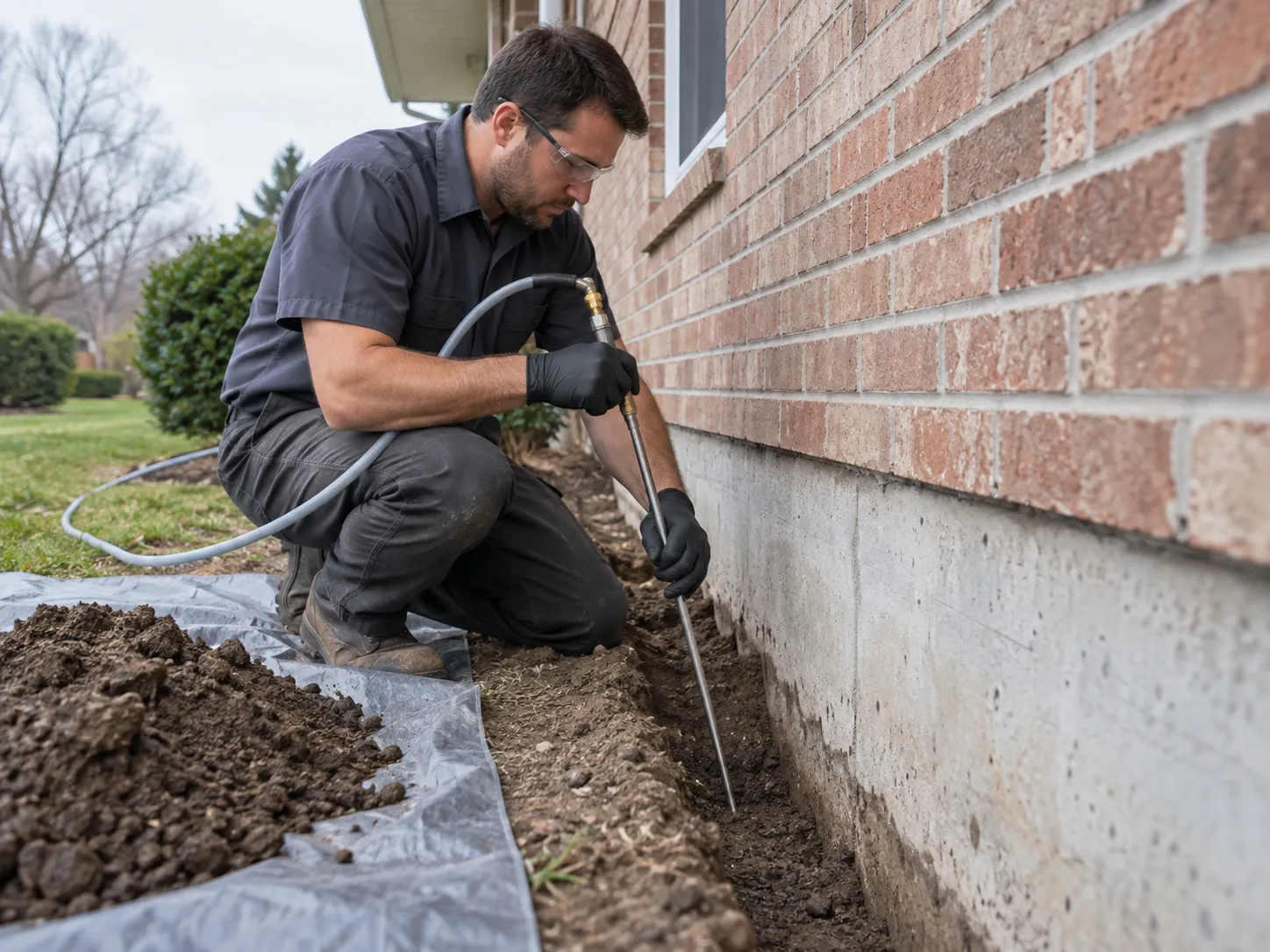
A liquid treatment places termiticide in the soil along and under the foundation so termites cannot reach the wood without passing through it. Outside, the technician digs a narrow trench against the foundation and treats the soil as it goes back in, often rodding deeper where the footing is low. Where there is a slab, a garage floor or a porch against the house, small holes are drilled through the concrete at intervals, the soil beneath is treated, and the holes are patched. In a crawl space, the soil along the inside of the foundation walls and around piers is treated too.
Modern termiticides fall into two groups. Repellent products keep termites away from the treated zone. Non-repellent products are undetectable to termites, which forage through the zone, pick up the active ingredient and spread it to others. Most professional liquid work today uses non-repellents, and the product label sets the concentration, the volume per foot of trench and the drilling pattern. University of Kentucky entomologists note that a typical job may use hundreds of gallons of diluted termiticide, and that liquid termiticides are meant to control termites for at least five years when applied according to the label.
- Trench along the outside of the foundation: the main treated zone.
- Down to the footing: rodding reaches soil the trench cannot.
- Inside the crawl space: soil along the foundation walls and around piers.
- Slabs against the house, such as a garage or porch: drilled, treated beneath and patched.
Termite treatment near me: when bait stations fit
Termite bait stations work on the colony instead of the soil. Plastic stations are set into the ground around the house, typically 10 to 15 feet apart, and checked on a schedule that ranges from monthly to once a year depending on the system. Once termites are feeding in a station, the technician adds bait: cellulose containing a slow-acting growth regulator that stops termites from molting. Workers carry it back and share it, and over weeks to months the colony declines. The system is only as good as its monitoring, so the contract should say how often stations are checked and what happens when activity is found.
Baits suit houses with wells or cisterns near the foundation, heavy landscaping, or slabs that would need extensive drilling. They are slower than a liquid treatment to protect the house, which matters if termites are already inside the walls. And once the colony is gone, a bait system leaves no residual pesticide in the soil, so letting the yearly monitoring lapse carries more risk than with a liquid treatment.
Termite tenting for drywood termites
Drywood termites do not need soil, so soil treatment does nothing for them. When the infestation is spread through the house or hidden in walls and the attic, the reliable option is whole-structure fumigation: the house is covered with tarps and filled with a gas fumigant that penetrates every piece of wood. People, pets and plants leave, food and medicine are sealed in special bags or removed, and nobody goes back in until the house has been aired out and cleared with a gas detector. Fumigation kills the termites present but leaves no protection behind, so a new colony can move in later.
For small, accessible infestations, local treatments are an option: termiticide injected into the galleries, heat, or borate applied to bare wood. The trade-off is coverage: a local treatment only works on the wood it reaches.
Termite exterminator contracts: retreatment or repair
A termite treatment is usually sold with a warranty that is renewed every year for a fee, along with a yearly inspection. The single most important line in it is what the company does if termites come back. A retreatment warranty means they treat again under the warranty but do not pay for damage. A repair warranty adds payment for new damage, usually up to a limit, and costs more to keep. Read what voids it as well: the EPA's consumer guide warns that structural alterations made without telling the company can invalidate it, and soil piled against the siding, wood touching the ground and untreated moisture are common exclusions. Many firms will not warrant a spot treatment at all.
Some states write these terms into law, and the rules are worth knowing even if you live elsewhere, because they show what a careful contract looks like:
- Florida requires the first page to say in bold whether the contract is for repair and retreatment, retreatment only, or no warranty, and to list the exact annual renewal fee. After written notice, the company has 30 days to inspect and 90 days to retreat.
- Texas requires a written estimate before treatment, with a diagram of the structure, the areas of activity, the product label and the full warranty terms. A spot treatment there means an area of less than ten linear or square feet.
- Louisiana requires termite contracts to guarantee at least one year, to include an inspection before they expire, and to be reported to the state every month.
Termite treatment cost: what the quote is based on
Liquid treatment is priced by the linear feet of foundation, with extra for drilling slabs and for difficult access. Bait systems are priced by installation plus a yearly monitoring fee. Fumigation is priced by the cubic footage of the house under the tarps. Two quotes for the same house can differ widely because they describe different methods or different coverage; the pest control cost guide explains how to line them up.
Liquid, bait or tenting: common questions
Which is better, liquid or bait?
Neither wins everywhere. A liquid treatment puts a protective zone in the soil right away and suits houses where the whole perimeter can be reached. A bait system works more slowly by colony elimination and suits houses where trenching or drilling is hard, or owners who want less soil treatment. Many companies offer both; ask why they recommend one for your house.
Do drywood termites need tenting?
Not always. Whole-structure fumigation reaches every piece of wood in the house, which matters when the infestation is widespread or hidden. Small, accessible infestations can sometimes be treated locally. The inspection report should say how far the activity extends before anyone recommends a method.
How long does the protection last?
It depends on the product, the soil and what happens around the house afterward. Soil disturbed by landscaping or new construction can break a liquid treatment zone, which is one reason termite protection is sold with yearly inspections and renewals rather than as a one-time job.
Can I treat termites myself?
Retail products exist, but treating subterranean termites means placing termiticide continuously around and under a foundation, often by drilling slabs, and most termiticides used that way are sold for professional use. The label is the legal instruction for any product, including the amount and the method.
Will my homeowners insurance pay for termite damage?
Usually not. Standard homeowners policies generally exclude damage from insects and vermin as a maintenance issue. That is why the repair-or-retreatment terms of a termite warranty matter so much.
Sources
- US EPA, Termites: How to Identify and Control Them
- University of Kentucky Entomology, ENTFACT-604, Termite Control: Answers for Homeowners
- University of Kentucky Entomology, ENTFACT-639, Termite Baits: A Guide for Homeowners
- UC IPM, Drywood Termites (Pest Notes 7440)
- Florida Statutes 482.227 and Rule 5E-14.105, termite contracts
- Texas Administrative Code, 4 TAC 7.174, termite disclosure
- Louisiana Administrative Code, Title 7, Part XXV, Structural Pest Control (2025)
- US EPA, Citizen's Guide to Pest Control and Pesticide Safety