
Latrines, one-way doors and relocation rules.
Attics, decks and crawl spaces
Wildlife removal: who may take an animal out of your house, and how
Wildlife removal is not pest control with bigger traps. Raccoons, squirrels, bats and the rest are handled under state wildlife law, often by operators licensed through the wildlife agency rather than the office that licenses exterminators, and the job is not finished until the openings are closed.
Call (844) 307-8876Wildlife calls cover bats, squirrels, raccoons, opossums, skunks, birds, snakes, moles and rats at homes the caller owns.
Reviewed September 24, 2026. Facts on this page are linked to their public sources at the bottom.
Wildlife control is licensed by a different office
Pesticide work is licensed by a state pesticide agency, usually the department of agriculture. Trapping and removing wild animals is a wildlife question, and many states handle it through the fish and wildlife agency instead. A few examples show how that looks in practice:
- Connecticut licenses Nuisance Wildlife Control Operators through its environmental agency. They may evict an animal, trap and release it on site, or trap and euthanize it, and they can do the repairs.
- Pennsylvania works through the Game Commission, which issues permits to nuisance wildlife control operators and publishes the practices they must follow for bats in buildings.
- Florida lets pest control companies trap commensal rodents under a limited certificate for non-chemical methods, but its pest control law states plainly that it does not exempt anyone from the rules of the Fish and Wildlife Conservation Commission, which sets the rules for taking nuisance wildlife.
- Wisconsin protects its bats; it is illegal to kill them, so the only legal route is exclusion.
When you compare companies, ask which license or permit covers the animal in your house. The pest control license lookup by state lists the pesticide agencies; for wildlife permits, the state wildlife agency is the place to check.
Animal removal, step by step
A proper nuisance wildlife removal job runs in a set order, and quotes that skip a step tend to cost more later.
- Inspection. Find every entry, active or not, from the roofline to the foundation, and identify the animal from tracks, droppings, damage and timing.
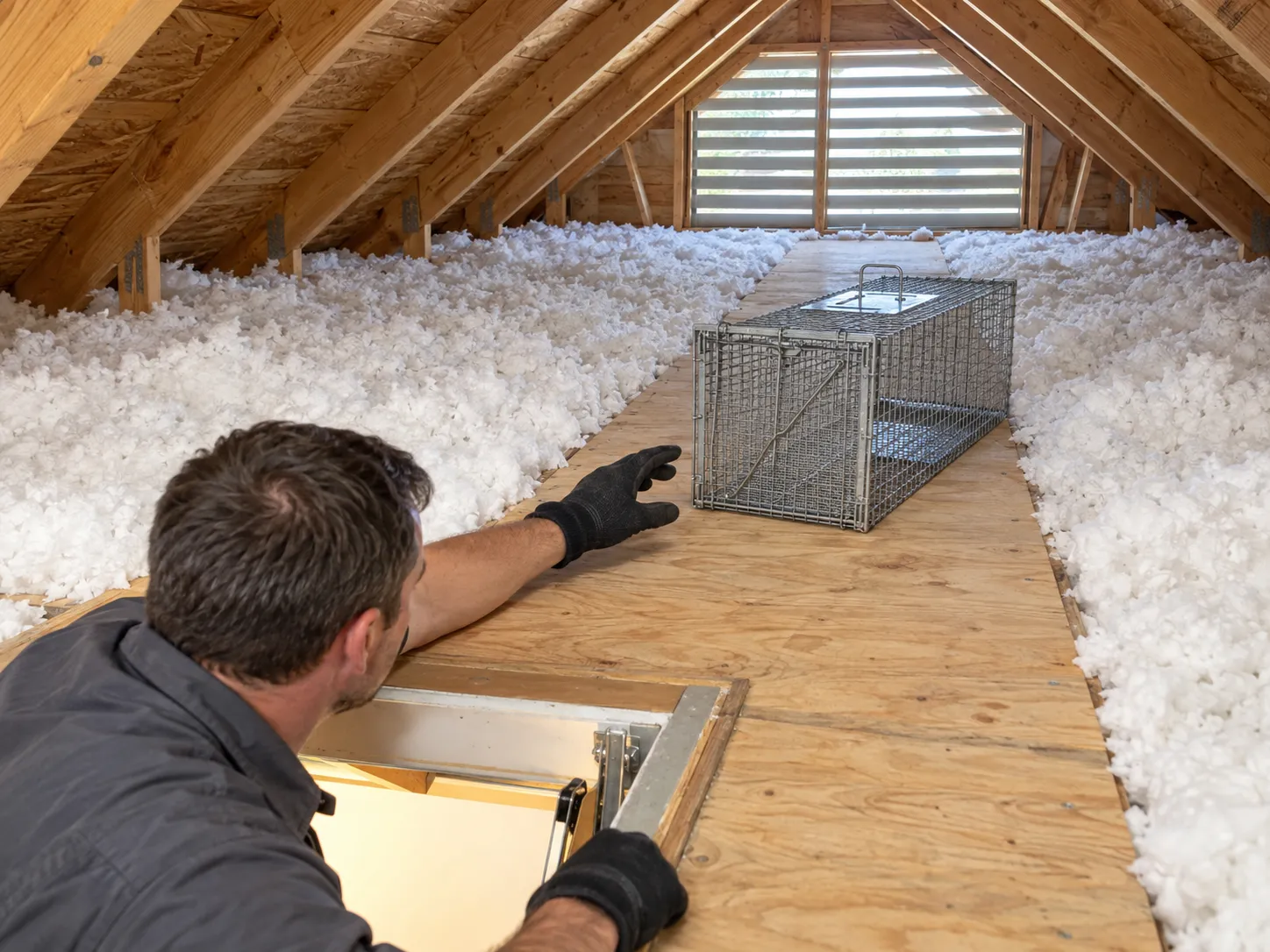
- Getting the animal out. A one-way door over the main entry lets the animal leave and not return; live traps are used where one-way doors will not work and the law allows them.
- Confirmation. Checks until there is no more activity, with extra care in the months when young may be inside.
- Sealing and repair. Close the openings with materials the animal cannot chew or pull apart: steel mesh, hardware cloth, sheet metal, chimney caps.
- Cleanup. Remove droppings, nesting material and soiled insulation where needed.
Relocation is where homeowners most often get into trouble. Connecticut, for example, does not allow trapped raccoons to be moved elsewhere because of the risk of spreading rabies. Before you set a trap yourself, find out what your state allows.
Nuisance wildlife removal, animal by animal
Raccoons, squirrels and bats have their own guides: raccoon removal, squirrel removal and bat removal. The rest are covered here.
Opossum removal
Opossums den under decks, porches, sheds and in crawl spaces, and they move on often. The usual fix is to confirm the den is empty, install a one-way door, and then close the space with a wire barrier bent outward and buried along the bottom edge so the animal cannot dig back under.
Skunk removal
Skunks use the same spaces as opossums and are handled the same way, with more patience: a startled skunk sprays. Operators set one-way doors or traps designed to keep the animal calm, and seal the space after the skunk is out.
Snake removal
Snakes come into garages, basements and crawl spaces after shelter or after the mice living there. A wildlife company identifies the snake, removes it, and seals the gaps along doors and foundations. If rodents are the draw, the mice exterminator guide is the other half of the fix.
Bird removal
Birds nest in dryer and bath vents, chimneys, soffits and gutters. The federal Migratory Bird Treaty Act protects native migratory birds; since 2004 it expressly does not apply to species introduced by people, and the Fish and Wildlife Service lists the rock pigeon among them, with the house sparrow and European starling in families the treaties do not cover. For a native species, timing and methods follow federal rules, which is a good reason to let a licensed company handle the nest before the vent is screened.
Mole removal
Moles live underground and feed mostly on earthworms and insect larvae; the raised ridges and mounds in a lawn are their tunnels. Trapping is the usual method, and the traps allowed differ from state to state, so a licensed company is the practical route.
Nuisance animals and the calendar
Timing is part of the law for some animals and part of good practice for all of them. Bats are the clearest case. Wisconsin does not allow exclusions from June 1 through July 31, to protect flightless young. Florida prohibits bat exclusion devices from April 16 through August 14 and allows them from August 15 to April 15. The northern long-eared bat was reclassified as federally endangered in 2022, which adds federal protection where it lives. For other animals, the question is simpler: are there young inside? Sealing a mother out and her young in turns one problem into two.
Wildlife removal services near me: what they cost
| Job | Range one guide reports | Source |
|---|---|---|
| Squirrel removal | $275 to $600, about $350 on average | Fixr, 2025 |
| Squirrel exclusion door | $200 to $600 | Fixr, 2025 |
| Squirrel damage repair | $150 to $1,500 | Fixr, 2025 |
| Bat exclusion | $250 to $650 | This Old House, 2026 |
| Bat guano removal | $500 to $8,500 | This Old House, 2026 |
Wildlife work is priced by trips and repairs more than by the animal. Several visits to set and check doors or traps, ladder work at the roofline and the materials for sealing make up most of the bill, and cleanup of soiled insulation can be the largest single line. The pest control cost guide explains how these lines add up.
Wild animals in the house: common questions
Can I trap an animal and release it somewhere else?
Often not legally. Connecticut, for example, does not allow relocation of trapped raccoons because of the risk of spreading rabies, and its licensed operators either release animals on site or euthanize them. Rules differ by state and by species, so check with the state wildlife agency or a licensed operator before setting a trap.
Is wildlife removal the same as animal control?
No. Municipal animal control usually deals with dogs, cats and public safety calls. Removing a raccoon from an attic or bats from a wall on private property is normally paid work by a private wildlife company, licensed or permitted by the state wildlife agency.
Why does it take several visits?
Because the animal has to leave before the opening is closed. One-way doors and traps need checking, often daily where state rules require it, and some animals, like bats, can only be excluded outside the months when young are in the roost. The final visit seals and repairs.
Who cleans up after the animal is gone?
Ask for it in the quote. Droppings, nesting material and soiled insulation can carry disease. The CDC recommends that raccoon latrines be removed before the parasite eggs in them mature, and its rodent cleanup steps apply to smaller messes.
What if a bat was in a bedroom overnight?
Call your doctor or local health department promptly. Federal rabies guidance treats a bat found in a room with a person who was deeply asleep, or with an unattended child, as a possible exposure that needs medical assessment, even with no visible bite.
Sources
- Connecticut DEEP, Problems with Raccoons
- Pennsylvania Game Commission, Acceptable Management Practices for Bat Control Activities in Structures (2023)
- Florida Statutes, Chapter 482 (2025), 482.157 and 482.183
- Florida Administrative Code 68A-9.010, Taking Nuisance Wildlife
- Wisconsin DNR, Bat FAQs
- US Fish and Wildlife Service, List of Bird Species To Which the Migratory Bird Treaty Act Does Not Apply (Federal Register, 2020)
- CDC, Raccoon Roundworm (Baylisascaris)
- CDC, Human Rabies Prevention, ACIP recommendations (MMWR, 2008)
- Fixr, Squirrel Removal Cost (updated 2025)
- This Old House, Bat Removal Cost (updated 2026)